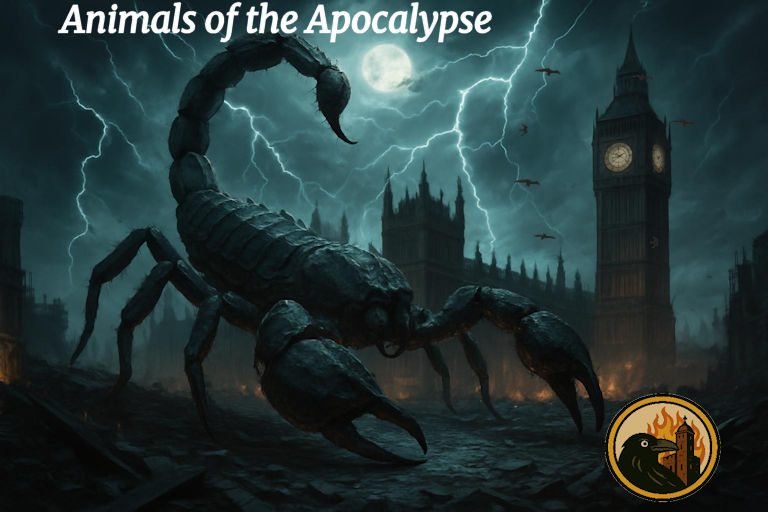
This blogpost looks at the animals that we have turned into signals of destruction. Through no fault of their own, they have been marked as apocalyptic. Recently, I saw an article in The Guardian about scorpions making the capital their home. Though these armoured insects turned out to be the size of fingernails, it made me wonder: which animals do we instinctively associate with catastrophe, omens, and post‑apocalyptic survival? If the phrase an approaching storm flags danger, can animals become shorthand for dread in fiction? And, which of those creatures have made London their home?
Below we look at some of the beasts that arrive already marked by the end of the world. Ravens at the Tower of London, the pale horse of Revelation, even the oarfish coiled in the deep; all of them carry a kind of mythic weight. Perhaps, as J. G. Ballard suggested in The Drowned World, our fear of certain creatures is ancestral. A survival instinct washed down from earlier ages, helping us spot danger before we knew it as such.
Across myth, folklore, and fiction, some of these creatures stalk London’s streets; others haunt the world’s mythologies. Some warn us; others thrive in what comes after. Together, they form the symbolic bestiary we draw from when imagining the apocalypse.
Harbingers of Doom: Animals as Omens
These animals don’t live in the ruins so much as announce them. These are the heralds. The silhouettes on the horizon that tell us the world is shifting.
Horses – Riders of the End
Imagine a blood‑red sky torn open by thunder as four spectral horses charge forth. The Four Horsemen of the Apocalypse remain the most iconic apocalypse animals in Western mythology. In Revelation 6, the first four seals open and the riders arrive:
- Conquest – A white horse. Its rider carries a bow.
- War – A fiery red horse. A great sword is given him.
- Famine – A black horse. Its rider holds scales to measure scarcity.
- Death – A pale horse. Its rider is named Death, with Hades following close behind.
To Christians, their arrival marks the beginning of the Tribulation; the countdown to the end of the age. Even now, the image of these horses cresting the horizon carries visceral weight, conjuring landscapes stripped of mercy and order.
But not all omens thunder in; some simply watch.
Ravens & Crows – Shadows of Kingdoms
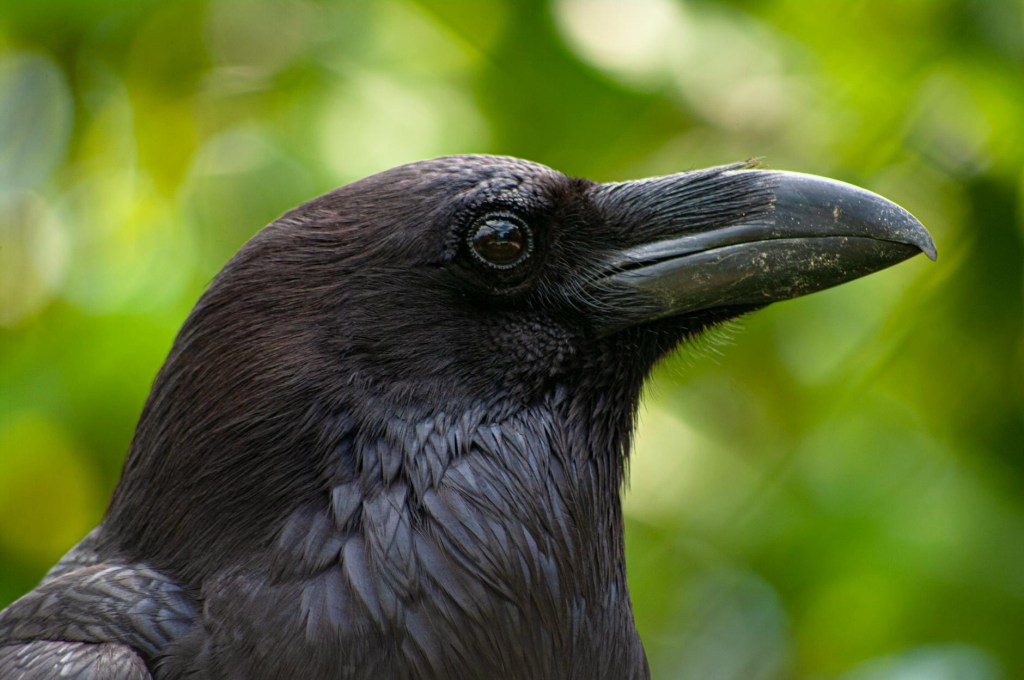
This symbolic shorthand is alive in modern post‑apocalyptic fiction, from The Road to Station Eleven, but in London the omen‑laden thread tightens around the Tower’s ravens. At RavensWatch, it would be negligence not to mention these winged messengers. When the collective noun for crows is a murder, the language itself leans toward the macabre.
The ancient legend that the kingdom will fall if the ravens ever leave the Tower of London turns a small flock into living omens – arguably the most famous apocalyptic animals in British folklore.
We’ve written before about the haunting tap‑tap‑tapping of Poe’s The Raven, but beyond poetry the bird is a perennial watcher of collapses. In battles, in ruins, and in dreams, it appears as the silent witness to the last breaths of empires.
From the sky, we descend into the sea.
Oarfish – Messengers of the Sea
In Japanese folklore, the ribbon‑like oarfish is called a “doomsday fish.” Believed to be a messenger from the Sea God’s palace, it rises from the deep before earthquakes and tsunamis. Its serpentine body floats near the shore like a warning from the ocean.
In our age of climate‑driven floods and storm surges, the image feels eerily modern: a creature that arrives not to herald apocalypse exactly, but to remind us that the sea has its own calendar.
And from the deep, we return to the land.
Black Dog – Celtic Death‑Watcher
In Celtic mythology, the black dog appears as an omen of death. Silent, enormous, and often described as spectral, it walks beside battlefields, crossroads, and lonely roads. Seeing it doesn’t always mean immediate doom, but it signals that the veil between the living and the dead has thinned.
As a symbol, the black dog is the quiet companion of ruin – alert, patient, and always a little too close to anyone who wanders the edges of the city at night.
When we catch sight of these creatures, the city’s apocalypse feels not like a future event, but a quiet, creeping reality.
Once the omens gather, it is not long until the city begins to rot.
Here Be Decay: Scavengers of the Post‑Apocalyptic City
Once the heralds pass through, the world begins to show its wounds. The animals that follow are scavengers, creepers, and survivors of rot. These creatures thrive where civilisation has lost its grip.
Vultures – Omens Above the Wasteland
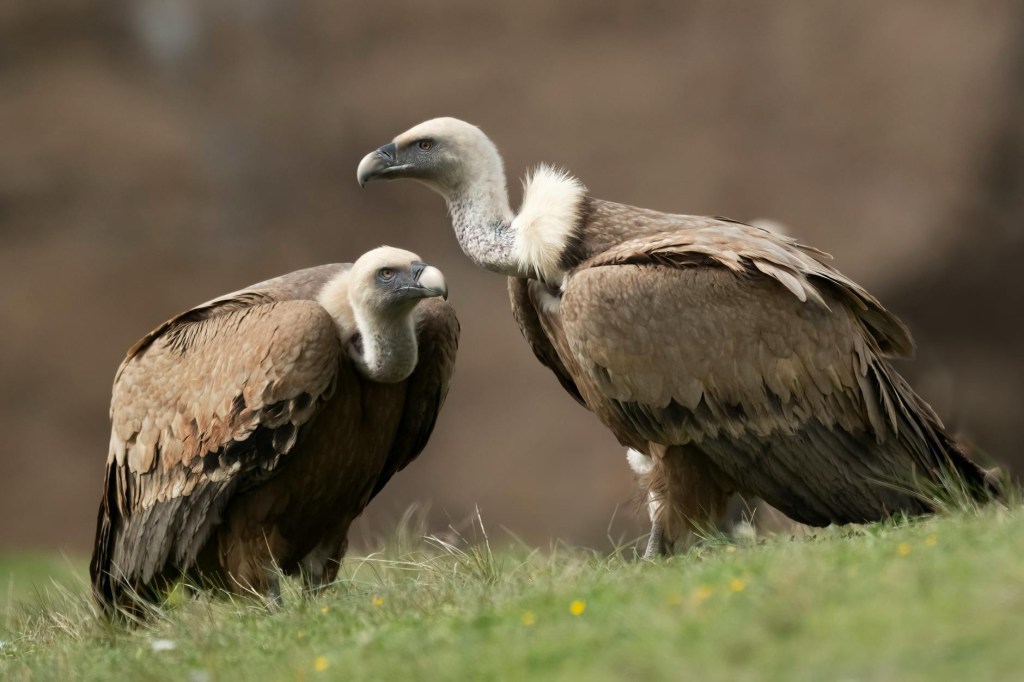
Vultures circle long before anything is dead enough to feed them. Sensitive to the approach of decay, they ride thermals that carry the scent of injured or dying animals. But when they begin to feast on humans, something fundamental has shifted: we no longer have time for our ceremonies.
In post‑apocalyptic stories, vultures over a ruined town or battlefield signal that the rule of the living has faltered. The dead are no longer tended. The living have other priorities – Let the dead bury the dead.
Rats – The City Unravelled
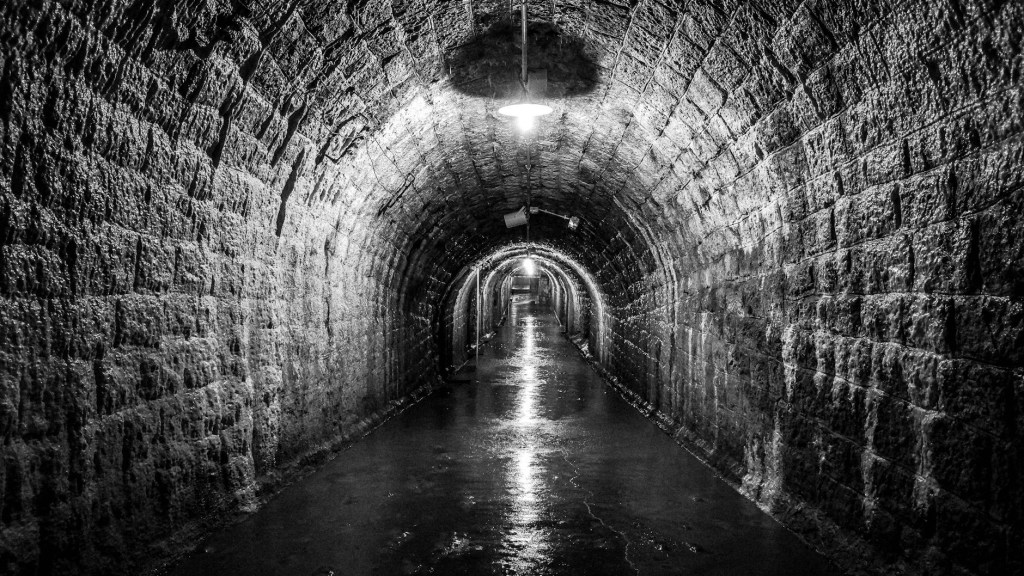
There’s a famous exaggeration about London: “You’re never more than six feet away from a rat.” The sentiment lingers like a bad smell, hinting at the hidden Other City beneath our feet.
James Herbert’s The Rats leans into that unease, turning the city’s undercurrent into a swarm of teeth, hunger, and tunnels. In apocalyptic fiction, rats are less enemy than symptom: they mark the loosening of human control, the return of the wild to sewers, streets, and abandoned homes.
And beyond these, the apocalypse has its supporting cast: serpents coiling through myth as agents of chaos, locusts descending like famine with wings, wolves prowling the edges of collapsing worlds. They are less characters than atmospheric pressure — the background radiation of dread.
In stories, these animals rarely appear by accident; they’re chosen to inject immediacy, unease, or a sense of nature’s ruthless reclamation. In the EPIX/Canal+ adaptation of The War of the Worlds, London’s pigeons drop from the sky. One dead bird says little; flocks hitting the ground together shout a warning. Meanwhile, London’s foxes, growing more brazen by the day, make us wonder who really runs the city.
The Mirror at the End
In our climate‑ravaged, pandemic‑scarred world, these animal omens hit harder. As wildfires rage and species vanish, vultures circle real wastelands. Post‑apocalyptic novels such as The Road or Station Eleven use animals to ground despair; deer freeze mid‑flight at the sight of humans, dogs turn feral, and birds vanish from the sky.
They force us to ask: are we the riders of the apocalypse, or merely beasts caught in the same swarm we have unleashed?
The truth is simple: animals do not herald the End Times. They reflect the times we are living through. Every omen is a projection. Every creature is a mirror. And sometimes, when London feels a little too strange, we look into that mirror and see the stories we’ve been telling ourselves since the first firelit nights.
The scorpions aren’t warning us. They’re reminding us that the world is older, stranger, and far less settled than we pretend.
Which apocalypse animal chills you most? Do the mice on the Underground make you feel like a visitor to their world, or do you get a cold shiver when you see a crow watching you at dusk?
Share your thoughts in the comments, and browse more post‑apocalyptic sci‑fi reads on RavensWatch for your next dose of dread‑filled literature.
Further Reading: If you want to read more about UK scorpions then pop over to Jason Steel’s website
🦂
 Ravens Watch
Leave a comment