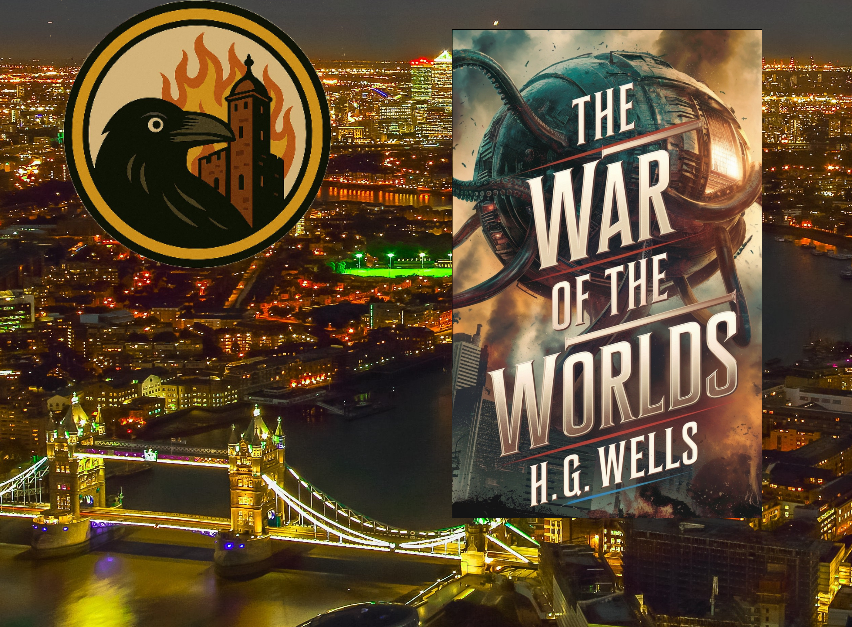
Author: H. G. Wells
First Published: 1898
Cause: Aliens from Mars
TL;DR
A stark, relentless vision of invasion and collapse, where London becomes a stage for humanity’s fragility and the quiet terror of the unknown.
What It’s About
H.G. Wells’ The War of the Worlds follows an unnamed narrator as strange cylinders fall from the sky and reveal towering Martian tripods armed with heat‑rays and black smoke. What begins as curiosity turns quickly to panic as the invaders sweep across Surrey and into London, dismantling the familiar world with terrifying efficiency. The novel tracks the narrator’s flight through a collapsing England – empty streets, ruined suburbs, and a capital city on the brink – while humanity struggles to comprehend an enemy that feels both mechanical and godlike.
It’s less a story of resistance than a study of shock: how quickly order dissolves, how small we become when the world tilts.
Review
War of the Worlds has been re-imagined so many times that it feels like a modern story to us. To think that, when it was published, Queen Victoria was sitting on the British throne and the USA was on its 25th president, William McKinley, maybe helps us date how old this classic story is.
The open chapter is called ‘Eve of War’, which is typically a tense and nervous time as people hope for the best but plan for the worst. The unnamed narrator of the story makes it clear that this eve is marked with blissful ignorance. The world spins, and humankind busily goes about its mundane tasks. Even when the Martians have landed, there’s still a relaxed curiosity about them, rather than panic. The first-person telling of the invasion pulls the reader into the story and makes it feel all too real. It has always been the realness of the story that has kept it relevant, that, and the eye for detail. The famous 1938 radio broadcast narrated by Orson Welles picked up on that feeling of realism.
The people we meet in these apocalyptic stories are always key. In The Death of Grass, we accompanied a civil servant who provided insight into how the government was planning for the future. In The War of the Worlds, we first meet a member of the military and then a man of the cloth. From the military man, we learn the aliens have the upper hand, and our standard weapons are failing. When we meet the curate, we gain no answers, only further questions. Wells makes it clear that the answer does not lie in our power or that of the heavens.
One thing that strikes a modern reader is the slow pace at which news travels. We now live in a world where events from the other side of the globe are known practically instantly, it seems strange to read about London being in the dark about an alien attack that is starting practically in its backyard. This aspect of the story leads us to think about how reliant we are on computer networks and what would happen if they went down. In a world where radios, telephones and televisions are digital, what do we do when the zeros and ones stop?
Once the newspapers have the story, though, Wells paints a vivid image of the storm of fear that grips the capital. The dismissive ways the aliens were described – slow, dragging, trapped – suddenly changes as special editions of the London papers are published. Wells ramps up the terror of Londoners as they desperately try to escape to the north or east. By having the narrator share his brother’s experience within the city, he continues to build the bond with the main character and keeps us firmly by his side.
The one theme that runs throughout the book is that to these aliens, humans are nothing more than insects. Wells uses verbs we associate with ants and describes Londoners escaping as tiny black dots. The message is as clear as it is unwanted. Even the most solid human structures crumbled before the might of the Martians. Battle ships and guns all fall silent to reinforce the message of alien dominance.
The detail Wells goes into concerning the aliens is extraordinary. In many modern books, the aliens are portrayed as one-dimensional killing machines, but that is not the case in this book. Despite its relatively short length, a comprehensive review of the Martians is provided. From reproduction to industrial development. I’m sure this eye for detail has been part of the reason this book is still in our top science fiction lists.
Of course, Wells also takes the time to examine the nature of humankind. When the planet Mars was threatened, its inhabitants developed a plan and carefully monitored its implementation to ensure it would work. Meanwhile, with Earth under threat, humankind makes no such attempt to unite. We shove each other out of the way, steal from our neighbours, and even quarrel over who gets the best view of our destruction. We try to work out how the Martians silently communicate as they work, but accept unquestionably that our selfishness spreads without words.
No one who loves science fiction needs to be told to read this book, as they already have – many times.
Who This Book Is For
- Readers who enjoy apocalyptic fiction with a historical edge
- Fans of atmospheric London settings, especially those that unravel
- Anyone interested in early science fiction and its influence on modern invasion narratives
- Readers who like stories where the terror is as much existential as physical
- Those who appreciate concise, precise prose that still carries mythic weight
Verdict Box
Tone: clinical, eerie, apocalyptic
Pace: brisk, escalating, observational
Best for: fans of classic SF, invasion stories, and atmospheric London fiction
Overall: a foundational work of science fiction that still carries a surprising, unsettling power
Extra: Track The Martians
If you want help picturing the route the Martians took to London, then have a look at this Battle Map.
Final Thoughts
The War of the Worlds remains unsettling not because of its Martians, but because of its clarity. Wells writes with the cool detachment of someone watching a familiar world slip underwater, and that restraint makes the horror sharper. London becomes a ghost city in real time – trains halted, crowds surging, the sky lit by impossible machines. Even now, the novel feels eerily plausible, a reminder that civilisation is a thin crust over something far more fragile.
It’s a book that lingers: not as a spectacle, but as a quiet, persistent unease.


 Ravens Watch
Leave a reply to The War of the Worlds Battle Map – Ravens Watch Cancel reply