
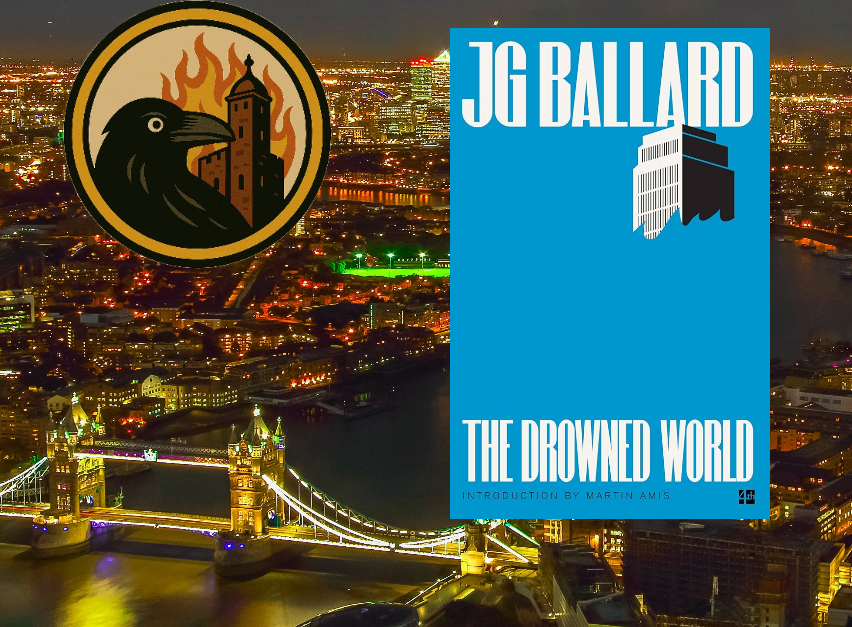
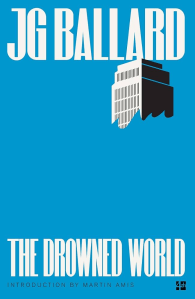
Author: JG Ballard
First Published: 1962
Cause: Flood due to melting icecaps
TL;DR
A feverish, dreamlike descent into a drowned, prehistoric London where heat, memory, and identity melt together.
What It’s About
Set in a future where solar radiation has melted the ice caps and transformed Europe into a steaming tropical lagoon, The Drowned World follows biologist Dr. Robert Kerans as he surveys a flooded, prehistoric London. As temperatures rise and the city sinks beneath silt and jungle, Kerans and his team begin to experience strange dreams and a growing pull toward the south – a regression into deep evolutionary memory. When a rogue military unit arrives, the fragile balance between survival, obsession, and surrender to the ancient world begins to fracture.
Review
Mentioning floods caused by melting ice caps will trigger thoughts of global warming in a modern mind, but Ballard’s flood is from natural causes. In Drowned World, the focus is more on the environment impacting humankind.
Mention of global floods might also make people recall the story of Noah and the ark. In Drowned World, though, the planet is returning to the Triassic period, so maybe this story in time is set in a reversal of time going from the flood to the Garden of Eden.
The world’s sunken cities were caused by solar storms damaging the planet’s atmosphere and causing temperatures to rise. As humans migrated to the melting poles, the higher levels of solar radiation increased the rate at which mutations occurred, especially in amphibians, reptiles, and plants.
The book is split into two parts. The first half introduces us to the swampy jungle that is Drowned London. Where only skyscrapers poke out of the water and the heat slows everyone down. Our main character, the marine biologist Robert Kerans, has taken over a suite at the Ritz. His vantage point allows him to look out over the London lagoons and the many iguanas that now call the city home.
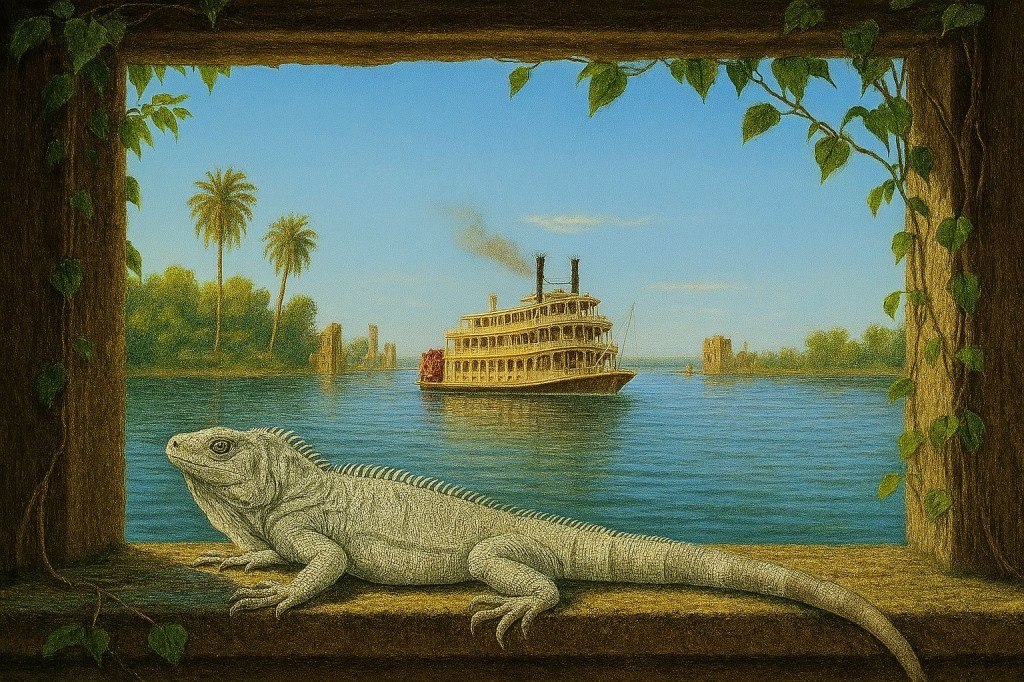
The running theme of the book is regression. Ballard looks at the idea that if the clock is turned back to early eras, could the same happen to us? Whether lessons learned from our ancestors are lying dormant in our DNA. That the knowledge could start to return if our environment drastically changed. Whether devolution could take us back to our sea-dwelling origins.
The book moves over the solar flares melting the ice caps and asks what happens if the apocalypse is not the end of the world, but just the end of humans. A planet reclaimed. Ballard vividly describes the replacement of us by insects and lizards — a return to the Triassic period.
In the second half of the story, the white-cloaked Strangman arrives with his hoard of alligators and treasure seeking crew. The energy Strangman brings is palpable. At first, the slowly devolving Kerans stand aside in surrender as the larger-than-life treasure hunter raids the abandoned city. Kerans is more concerned by his overriding desire to head south. Soon though, he begins to stand up to the newcomers.
Ballard tells an elaborate and clever story, but the question remains of what relevance is London? If all we experience is the tops of tall buildings, could this primeval swamp not be anywhere? The evacuation of the city happened well before the story is set, and there is no acknowledgment of how the city’s loss impacted the world. Of course, Ballard has an answer to this question. An answer that shakes up the world the characters have gotten so used to.
Who This Book Is For
- Readers who like atmosphere over plot
- Fans of eco‑fiction with a surreal edge
- Anyone curious about early Ballard and the roots of New Wave SF
- Readers who enjoy stories where the landscape is the real protagonist
Verdict Box
Tone: surreal, oppressive, hallucinatory
Pace: slow, hypnotic, inward‑turning
Best for: readers who enjoy psychological SF, Ballard’s later work, or climate‑ruined landscapes
Overall: a strange, visionary novel that reads like a nightmare you half‑remember from another life
Final Thoughts
The Drowned World lingers less as a story and more as a temperature – a feverish heat that seeps into the bones. Ballard isn’t interested in survival mechanics or plot machinery; he’s charting the slow unravelling of the human mind when the world around it slips back into deep time. It’s a novel that feels both prehistoric and futuristic, a dream of a planet remembering itself. Not everyone will connect with its drifting, hypnotic pace, but for readers willing to sink into its strange tide, it offers something rare: a vision of apocalypse that is beautiful, unsettling, and eerily serene.



 Ravens Watch
Leave a reply to Must Read Post-Apocalyptic Fiction – Ravens Watch Cancel reply