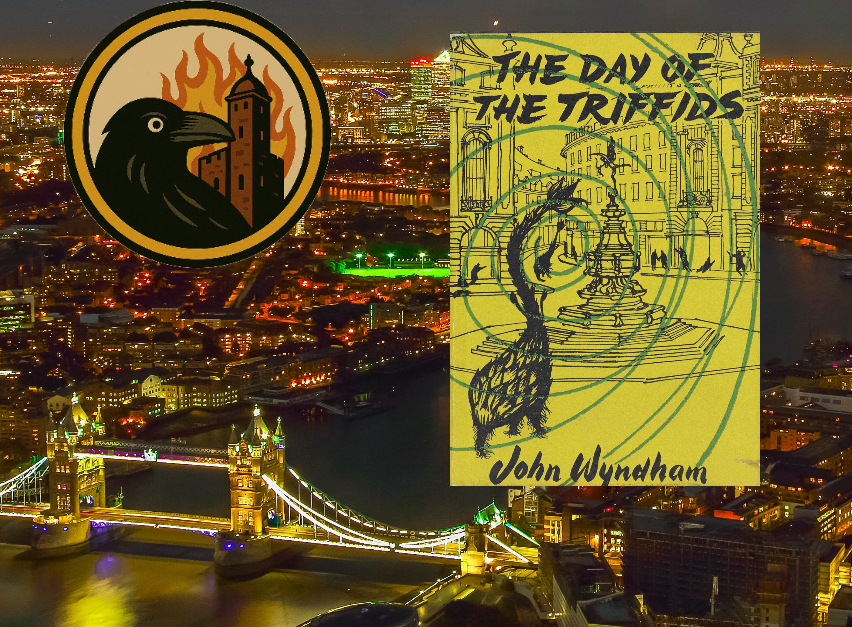
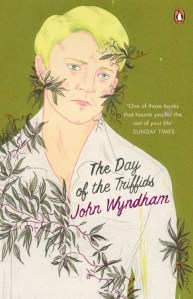
Author: John Wyndham
First Published: 1951
Cause: Cosmic light show blinds humanity.
TL;DR
A civilisation-ending light show, killer plants with a grudge, and a world suddenly forced to rebuild itself from the soil up. Wyndham’s classic isn’t just a disaster novel — it’s a quiet, creeping warning about how quickly the familiar can rot.
What It’s About
The Day of the Triffids opens with a simple horror: waking up in a hospital to find the world has gone blind overnight. Society collapses with startling speed, and into that vacuum step the triffids — bioengineered plants with a taste for human flesh and a patience that’s almost polite.
What follows is a journey through a Britain stripped of its certainties. Bill Masen, our reluctant guide, navigates abandoned cities, improvised communities, and the uneasy truth that the real threat isn’t always the thing with the stinger. Wyndham’s apocalypse is slow-burning, methodical, and unsettlingly plausible.
Review
Apocalyptic books usually cover surviving an event and dealing with the world afterwards. Some books, such as The World of the Worlds, focus on a limited time period, whereas Wyndham takes us over decades. His novel could be taken as an attack by plants, whereas it is the plants taking advantage of a catastrophic event. Wyndham looks at what would happen if the board were rearranged and humans were at a disadvantage.
The story is written in the first person and immediately starts with the cataclysmic event – a spectacular comet storm that lights up the world green. As our main character sits in his hospital bed recovering from an eye operation, the majority of the world gazes skyward.
Our protagonist, Bill Masen, first meets a doctor who quickly realises the gravity of the situation. Then, after watching blind patients stumble around, he heads to the nearest pub and meets a drunk landlord. Each interaction allows us to discover more about the world as we stumble around a fallen London.
Often, authors use separation from loved ones as a key motivation for their characters, but Wyndham removes this. By making Bill free of lovers and family, he frees up his actions. At the start of the story, there is the option of central London or the countryside, and we head straight to Piccadilly Circus. The hope is to find the start of a recovery plan, but a family would have changed that decision and taken away our chance to see the quickly unravelling Zone One of London.
As the story continues, Wyndham returns to this theme as Bill forms new relationships. We are asked to decide how we judge total strangers when all social norms have been removed. Is a social conscience something that needs to be forgotten when survival is the primary objective? At our core, we have a herd mentality, so how does it feel when the herd is removed?
It was not, I had to tell myself firmly, any good at all going into an earthquake area while the buildings were still falling.
Reading Wyndham is like watching him set up a chessboard. There is the main green cosmic light show above us, but the strange plants are already on the board. Humans believe they have control of this new species and cannot see any reason that their domination will change. As these strange walking plants begin to break their bounds, and bishop-like start a slow attack, we are asked how some creatures can act collectively and sacrifice self.
but in an environment reverting to savagery it seemed that one must be prepared to behave more or less as a savage, or possibly cease to behave at all before long.
The first half of Day Of The Triffids is set in London, but as the city descends, the survivors move out to the countryside. Once there, they start to question how they can build their future and give their children a desire to rebuild.
Wyndham’s writing remains a classic because a strong story keeps asking us how we would react. The characters are realistic and carry their pre-catastrophe stories into the book to make for a compelling narrative. A slow burner, but a definite joy for readers of post-apocalyptic tales.
Who This Book Is For
- Fans of atmospheric British sci‑fi with a moral spine
- Anyone who enjoys a creeping dread that arrives on soft, rustling feet
- Writers and world-builders who want a masterclass in “civilisation quietly unravels”
- Those who like their monsters symbolic, their heroes flawed, and their landscapes eerily empty
Verdict Box
Tone: Quiet dread with a British chill.
Pace: Slow, steady, unsettling.
Best For: Thoughtful apocalypse fans.
Overall: A classic of calm, creeping terror.
Final Thought
The Day of the Triffids endures because it understands that the end of the world isn’t loud — it’s lonely. Wyndham’s restraint is its power: no bombast, no melodrama, just a steady, creeping sense that the world has slipped its moorings and may never right itself.
It’s a novel that lingers. Not because of the triffids themselves, but because of the fragile, fumbling humans trying to rebuild something worth saving. A quiet masterpiece of British speculative fiction, and a reminder that the apocalypse might begin with something as simple as forgetting to close the greenhouse door.



 Ravens Watch
Leave a reply to 5 Must Reads: Natural Catastrophes – Ravens Watch Cancel reply