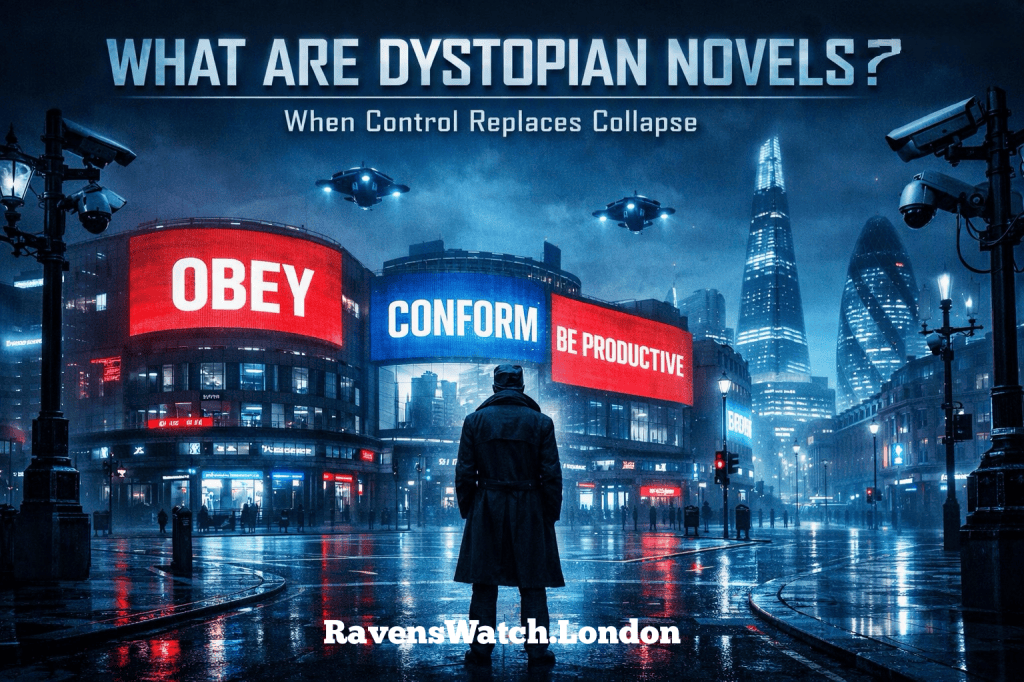
Dystopian novels imagine societies that have gone wrong – not destroyed, but twisted. They show us worlds where power, technology, ideology, or fear have reshaped everyday life into something recognisable yet disturbingly distorted. If post‑apocalyptic fiction asks how we survive after the end, dystopian fiction asks how we live when the world keeps going but becomes unbearable.
Writers use dystopias to challenge us with uncomfortable questions. What happens when a government controls every aspect of life? What if technology becomes a cage instead of a tool? What if society decides that freedom, truth or individuality are no longer necessary? These stories exaggerate the pressures of the real world to reveal what matters most to us.
People repeat the phrase “that could never happen here”, but it is the job of writers to show how easily that line could be crossed. Dystopian fiction pulls us into societies that function, but not in a way we would want. We are then asked if we would notice the cracks and if we would speak up.
What Makes A Society Dystopian?
A dystopia is defined not by collapse, but by control. The world still exists, cities still stand, people still work, eat, travel and live, but under systems that limit or distort their humanity.
Common features include:
- Oppressive governments — surveillance, censorship, propaganda, or absolute authority.
- Loss of personal freedom — restrictions on movement, speech, relationships or identity.
- Technological domination — tools that monitor, manipulate or replace human life.
- Social inequality — rigid classes, exploitation, or engineered hierarchies.
- Ideological control — enforced beliefs, rewritten history, or cultural manipulation.
When society functions but works against the majority of its people, that is when we are challenged to speak up.
Why Dystopian Fiction Matters
Dystopian stories hold up a mirror. They exaggerate the pressures of our own world – politics, technology, inequality, fear – and ask what happens if we stop paying attention. They warn us, challenge us, and sometimes inspire us.
Where post‑apocalyptic fiction asks how we rebuild, dystopian fiction asks how we resist.
Dystopian London
Capital cities always attract the creeping shadow of dystopia. Where a country’s power sits is the easiest well to poison. The Palace of Westminster, often called the mother of all parliaments, stands proudly on the river banks and is an ideal symbol for writers. In the graphic novel V for Vendetta, the palace is the ideal target for a man fighting a fascist totalitarian regime while wearing a Guy Fawkes mask.
Even apocalyptic novels that move into a post‑apocalyptic era often end up leaning into dystopian fiction as people realise the world looks very different once the old structures are removed. Take John Wyndham’s The Day of the Triffids: as survivors regroup, new rules, hierarchies and controls emerge, and the question becomes not just how to survive, but who gets to decide the rules of the new world.
Explore More
RavensWatch is the place to explore London after its fall within literature. Here are a few pages you might want to visit next:
- 5 Must-Read Novels – dystopian fiction
- Why London? – how the city attracts the end
- What are Post-Apocalyptic books – A look at the other side of the coin


Leave a Reply