As a mysterious blight destroys the world’s food supply, Britain fractures into chaos and the road from London becomes a gauntlet of fear, scarcity, and hardening choices. This review examines how The Death of Grass uses its collapsing landscape to explore the thin line between civilisation and savagery.
Alternative Title: No Blade of Grass
Author: Sam Youd
Pen Name: John Christopher
First Published: 1956
Cause: Environmental – Virus attacking food crops
Chapter One Opening Sentence: A quarter of a century later, the two brothers stood together by the banks of the Lepe.
TL;DR
A stark, unsettling classic of British apocalypse fiction that still feels disturbingly plausible.
What It’s About
The Death of Grass by John Christopher (1956) imagines a world undone by a mysterious virus that wipes out all forms of grass — wheat, rice, barley, the quiet foundations of civilisation. As famine spreads and governments collapse, a small group attempts to cross a rapidly unravelling England in search of safety.
It’s a simple premise, executed with a cold, almost documentary precision.
Review
The Flight from London
John Christopher’s novel imagines a Britain pushed to the edge by a crisis that begins far from home. We focus in on two London families creating an alliance to escape the city if a virus from the Far East forces the British government to make a terrible decision. As their panicked journey starts, they are soon joined others and are forced to deal with lawless strangers as England’s green and pleasant land turns black from the virus. What soon becomes clear is that some people prefer a feudal system over the abandoned governance of democracy.
Divides Beneath the Surface
The book starts with the divines that already exist in society: city vs countryside and putting the home country before distant lands. The foreboding of what is to come starts to brew quickly. A reminder that it only takes one tiny slip to set our world spinning out of control and raise questions of the nature of man.
The virus starting in China reads like it was written for the COVID-19 pandemic for a modern reader.
Talk of events being distant and such things would never happen in the UK will also sound familiar.
The Moral Narrowing
Post-apocalyptic novels always ask questions of the reader, and how they would respond differently in that situation is a common question. This novel starts by asking about helping people on the other side of the world, but soon narrows down that question uncomfortably to members of our family.
Atomic Age Anxiety
All books are of their time, and this one is written during the birth of the Atomic Age. It shows both the hope and fear of this new power. The story is set before World War Two and covers the journey to a promised land that is far from “grim seasons of London” in a believable way. The descent from a united nation to gangs that are out to take what they can is darkly realistic.
Inside the Government
By having a character inside the government, we get an insight into the decisions being made at the highest level. A chance for us to decide if the greater good is the best way to allow civilisation to survive. But it is also a harsh light on what it takes to make those sorts of decisions.
London’s Role
The story is not based entirely in London, but the dilemma of remaining in the city or running to the countryside is a familiar theme. The escape from London is handled in a chapter and forces our main characters to make a life-changing decision. For our main character, family is worth doing anything to protect. Although London as a city is not front and centre in this story, I feel the story looks at how Londoners would need to act. In a real disaster, the urge to leave the city will be felt by many, and the enforcement by the government to remain in place would cause much conflict.
Who This Book Is For
- Readers who enjoy bleak, understated apocalypse fiction
- Fans of The Road, Day of the Triffids, or The Chrysalids
- Anyone interested in mid‑20th-century British SF
- Readers who like moral ambiguity and slow‑burn dread
Verdict Box
Tone: bleak, restrained, morally complex
Pace: brisk, escalating
Best for: fans of classic dystopia and quiet apocalypse stories
Overall: a chilling, tightly written classic that still hits hard
Final Thoughts
The Death of Grass is a quiet gut‑punch of a novel — a reminder that civilisation rests on fragile, invisible things. Nearly seventy years on, its vision of societal collapse feels uncomfortably close to home. It’s a classic for a reason, and well worth revisiting.
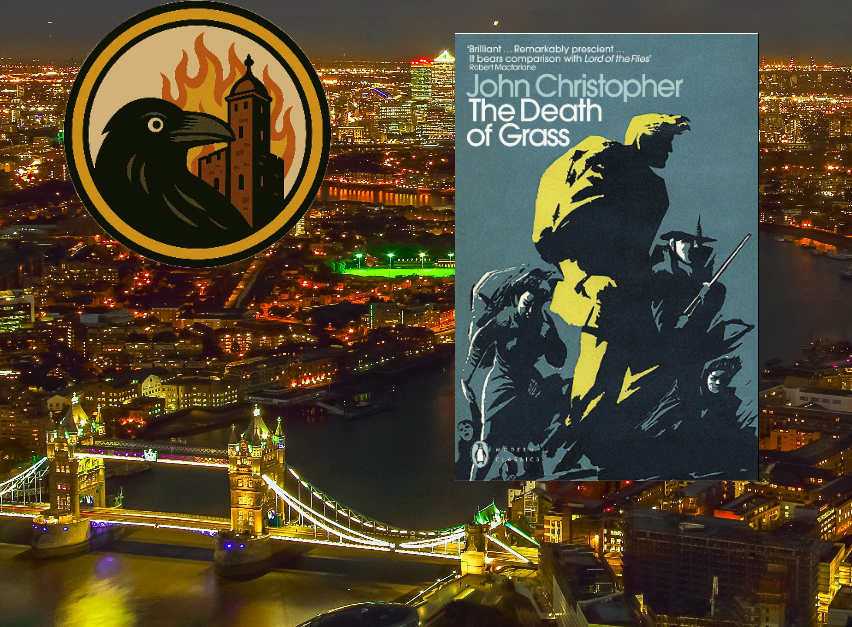
Book Cover




Leave a Reply