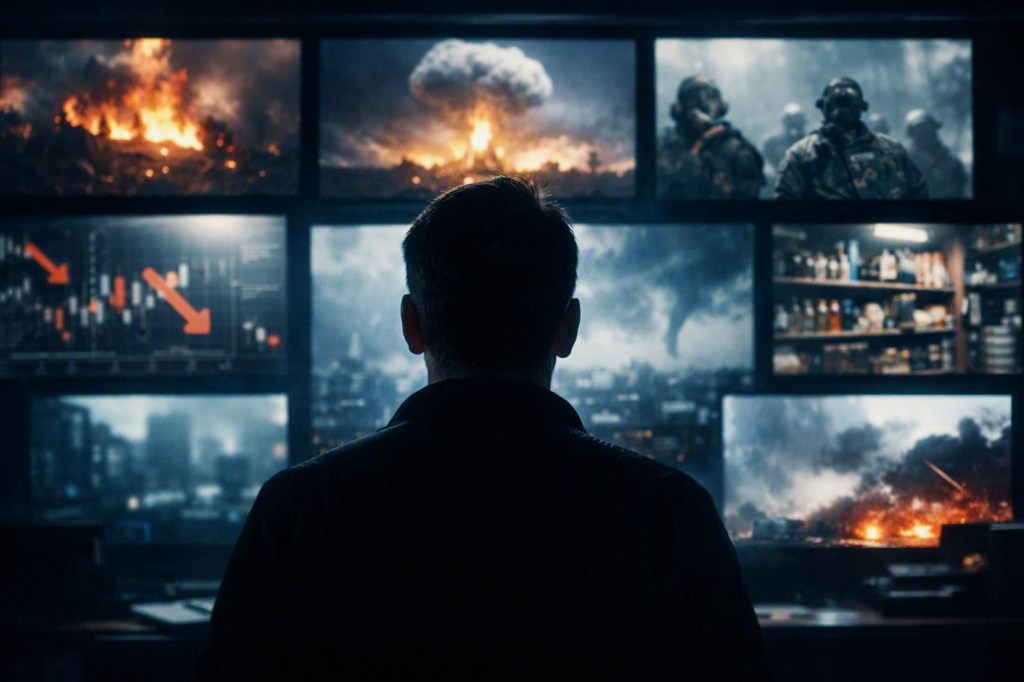
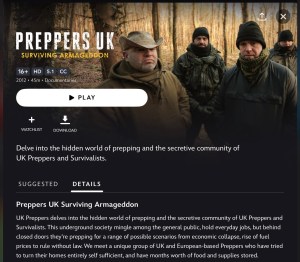
There’s a show on Disney+ called Preppers UK: Surviving Armageddon. It follows people so convinced society is about to collapse that they spend their money preparing for it. The fact that it aired in 2012 tells you everything. Like the Book of Revelation, there’s no deadline. It reflects a belief system that says the end is coming soon and these people are its followers. They dedicate time, energy, and resources to the promise of a future apocalyptic event. Every time a news story breaks, they mutter, “This is how it starts,” and check the best-before date on their dried food.
Humans are a resilient species, and many of us want to be prepared for our End of the World test. The tech-bro trillionaires used to be content with luxury bunkers in New Zealand; now they talk about the “need” for off-planet settlements. They’ve reversed the opening of The War of the Worlds. We have been turned into the ones scanning the skies for new home planets. There’s a shared sense that the end must be coming, and that we should be ready for it.
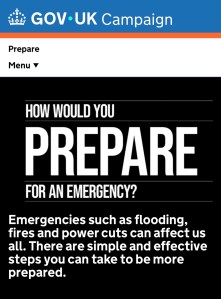
Even the British government has joined the chorus. In July 2026, ministers urged Britons to take “small but important steps” to prepare for national crises, including severe weather, cyberattacks, and disruption to water, power, phone networks, and food supplies. The government presented this as practical resilience rather than panic, but the language was unmistakably prepper-adjacent: a call for households to think ahead and prepare for the possibility that essential services might fail. It wasn’t the first time the UK government had asked citizens to imagine systemic failure – but it was the clearest. The state was telling us to imagine the end of ordinary life … and to make a plan.
We don’t just want to read or watch the apocalypse any more. We want the full immersive experience.
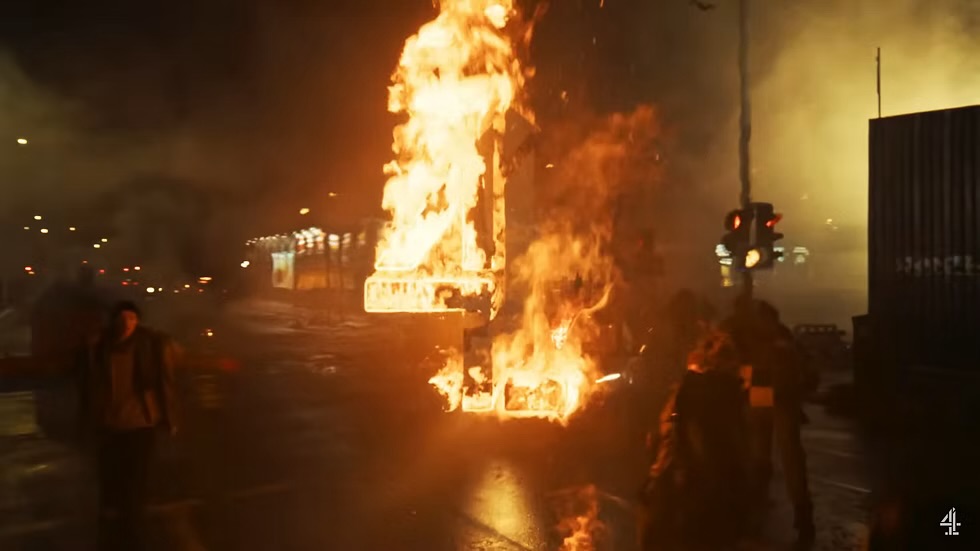
And if the apocalypse won’t arrive on its own, we’ll simulate it. In September 2026, Channel 4 aired a “reality” show called Apocalypse, a modern survival series that puts fourteen ordinary people from the UK and Australia into two groups and drops them into a real abandoned town. There’s no electricity, running water, or food. The participants must scavenge, recycle, reuse, and reinvent whatever they can find. The contestants talk about leaving their comfort zones, testing their survival skills, and proving something to themselves. It’s the same impulse as the preppers, just with better lighting and a production crew.
Across most of the books reviewed on RavensWatch, the pattern is the same: people are not prepared for what happens. In Flood, Doyle goes to great lengths to show how the British institutions designed to handle disaster have been located in the worst possible places, and how government plans are neither sufficient nor fast enough. Reading it after Covid, the novel feels less like a prediction than a blueprint for institutional failure. In The Death of Grass, the two main families use insider knowledge to escape early – and even that fails.
The lesson in all these stories is simple: people don’t grasp the magnitude of the event, and they don’t act quickly enough. Once the crisis begins, the sheer number of people trying to protect themselves and their loved ones makes it impossible to move fast. Fiction teaches us that hesitation kills.
But real life teaches something different.
People often talk about the fall of Rome as the ultimate civilisation-ending event. But – to misquote the saying – Rome didn’t fall in a day. It didn’t fall in a decade. It seeped away over centuries. Nero didn’t play his fiddle. That story survives because we prefer a single villain with an instrument to centuries of political instability, economic pressure, military overreach, and institutional decline.
We want drama, villains, signs in the sky, and a single moment we can point to and say: that’s when it all went wrong.
And London, of course, is the perfect stage for this obsession – a city that has survived plague, fire, flood, blackout, blitz, and austerity, yet still imagines the next test waiting just around the corner. We turn flood maps into plot outlines and Tube closures into dress rehearsals for collapse. The Thames Barrier is a piece of infrastructure, but it is also a reminder that even a city as old and confident as London depends on systems that can fail.
Apocalypse fantasies are oddly classed. For some people, they are a thought experiment: a chance to imagine what they would do if the lights went out and the shelves emptied. For others, power cuts, food insecurity, insecure housing, and bureaucratic failure are not imagined futures. They are familiar parts of life. There is a difference between choosing to spend money on a bunker and having no money left for an emergency supply because the rent went up again.
Reality is slower. Messier. Less cinematic than fiction.
But we keep reaching for the apocalypse anyway. We need the clarity the real world refuses to provide. A disaster gives us a beginning, a turning point, and an enemy. It tells us when normality ended and what must be done next. That’s the gap RavensWatch is interested in: not how to survive the end, but why we keep writing, reading, and re-staging it.
That may be why our Reviews page is full of endings that happen in a single night, even though real collapse takes decades. The apocalypse is not just a threat. It is a narrative machine. It converts gradual, complicated change into a story with consequences we can see.
If the apocalypse is a test, perhaps the real question isn’t whether we would survive it, but why we need to imagine being tested at all.


Leave a Reply