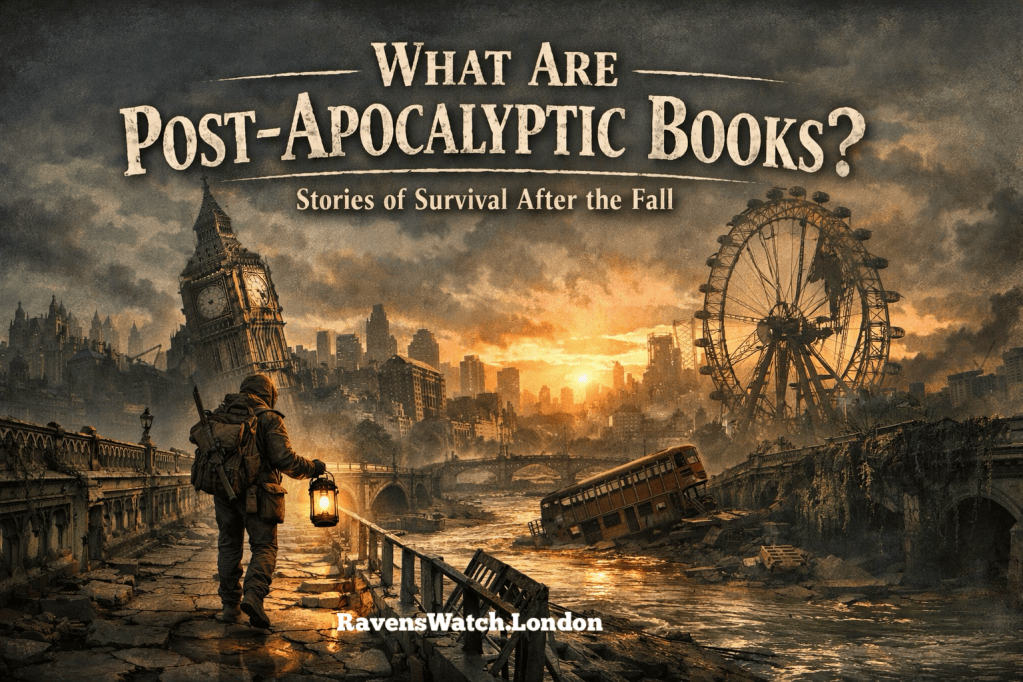
Post‑apocalyptic novels are stories set after a catastrophic event – a war, a plague, a climate collapse, a technological failure – where the old world has ended and a new one is struggling to begin. They ask a simple but enormous question: what survives when everything else is gone? This page explores how writers use London as a pressure point for these stories, and why the city appears so often in tales of survival and ruin.
Writers have always used extreme situations to challenge us. Shakespeare’s Macbeth asks whether a man who chooses evil can ever escape its consequences. Apocalyptic storytellers ask something different: if the world ended tomorrow, what would matter?
This question isn’t only answered in literature. Some of us want the answer in ten‑second videos, some want sprawling TV seasons, and others want to be dropped into a first-person game. Whatever the format, these stories pull us out of the everyday and show us how life could be radically different. And, as we have already looked at in Our Need For The Apocalypse, it’s a situation we love to explore.
RavensWatch focuses on the catastrophic endings, but also on the beginnings that follow. Post‑apocalyptic fiction begins after the disaster, in the silence that follows the shock. It’s about survival, rebuilding, and discovering what remains when the familiar world is stripped away.
What Is The Apocalypse?
The word apocalypse comes from the Greek apokalypsis, meaning “revelation” or “unveiling”. Its association with the end of the world was shaped heavily by the final book of the Christian Bible, the Book of Revelation. In that vision, the first heaven and the first Earth pass away, followed by the appearance of a new heaven, a new Earth, and the descending city of New Jerusalem. The Apocalypse is a sequence of divine judgements – war, famine, plague, cosmic upheaval, torture, mass death, and a final battle – before the old creation ends.
That’s the root of apocalyptic storytelling: a world-ending event that leads to a transformed world. Sometimes better, often worse, always different. Post‑apocalyptic novels pick up after this moment and ask how people live in the ruins.
Beyond The West
Although the Christian idea of the apocalypse was shaped decisively by the Book of Revelation, stories of cosmic destruction and renewal long predate it and appear in many cultures. Hindu cosmology describes vast cycles of creation and dissolution, in which the universe may be consumed by fire or submerged before being renewed. Norse mythology gives us Ragnarök, where the gods fall, the world is destroyed, and a new green world rises. Particular Indigenous traditions from different parts of the world also preserve stories of floods, fires, or other world-transforming disasters, though these traditions are diverse and should not be treated as a single system. These stories are not identical, but many share a recurring pattern: destruction followed by transformation. Modern post-apocalyptic fiction inherits one version of this ancient narrative impulse – the belief that the world can end, and that something different may begin.
What Is Armageddon?
We also get Armageddon from the Book of Revelation, where it names the place to which the kings of the Earth are gathered for the final confrontation. The name is usually connected with the Hebrew Har-Megiddo, or “the mountain of Megiddo”. Over time, Armageddon has become the name of a single, world-ending event. Even when writers use it metaphorically, the word still carries that sense of a unique final catastrophe, so it keeps its capital letter.
Post‑Apocalypse London
London has qualities that attract these stories. RavensWatch has already discussed why London falls so perfectly. That article looks at how writers choose London because it carries weight. It’s political, cultural, historic, crowded, symbolic. When London breaks, it gets noticed. That’s why so many post‑apocalyptic novels begin here – the city is a perfect pressure point for imagining how civilisation fails and what comes after.
This website exists because of a strong library of books that use the city as a character in their stories. J. G. Ballard’s The Drowned World places a story in a flooded London and looks at how the people there are affected after a disaster. A Long Walk To Wimbledon shows a broken city and how people cope when the scaffolding of civilised society has been removed.
Often, these stories start in London but then spin out into the wider country. One of the earliest significant English-language post-apocalyptic novels is Richard Jefferies’s After London. Authors know that people would feel a need to get away from big populations and into smaller communities. The Day Of The Triffids and The Death Of Grass both depict people escaping the metropolis in search of safety and the possibility of renewal in the countryside.
Explore More
RavensWatch is the place to explore life after Armageddon within literature. Here are a few pages you might want to visit next:
- 5 Must-Read Novels – apocalypse fiction
- Why London? – how the city attracts the end
- The Death Of Grass – review of this key piece of literature
- London Bridge Is Falling Down – a look at the rhyme


Leave a Reply