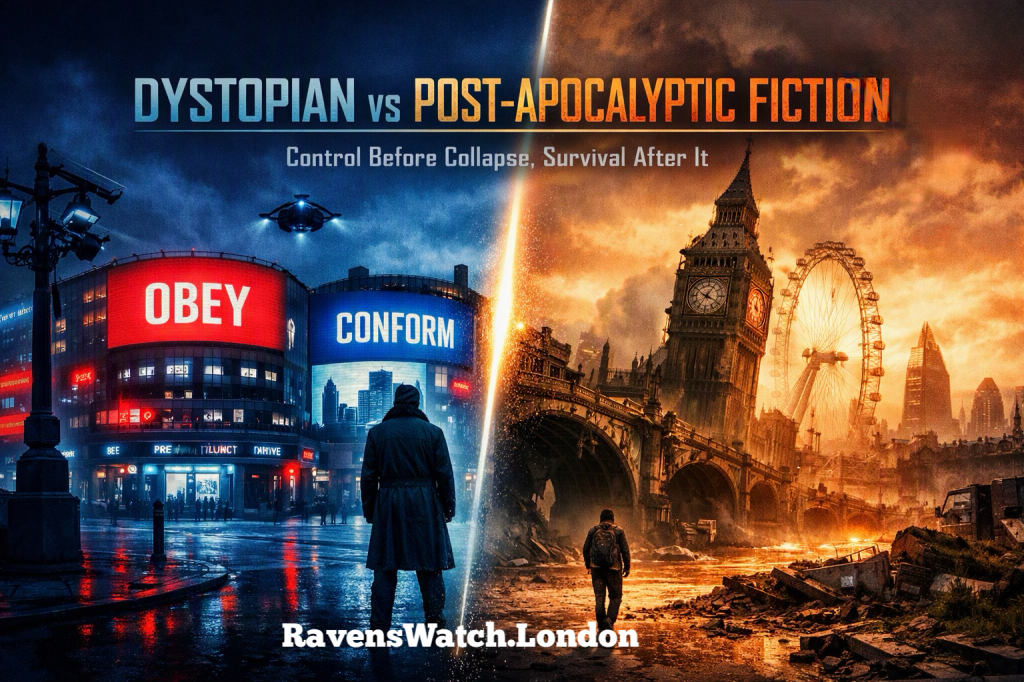
Readers often confuse dystopian fiction with post‑apocalyptic fiction because both deal with danger, collapse, control and survival. But they explore different moments in a world’s life. One imagines a society that has gone wrong; the other imagines a world that has already ended. Understanding the difference helps us place books in the right tradition — and see what each one is really saying about power, survival and what comes next.
How Dystopian Fiction Differs From Post‑Apocalyptic Fiction
This is the distinction readers constantly search for:
- Post‑apocalyptic: the world has ended; the story focuses on survival and rebuilding.
- Dystopian: the world continues; society becomes oppressive or distorted.
Dystopian fiction asks: would you stay quiet? Post‑apocalyptic fiction asks: what would you do to survive?
A dystopia may follow an apocalypse, but it doesn’t require one. A post‑apocalypse may become dystopian, but it begins with collapse.
Examples of Dystopian Fiction
- High Rise – class division, social isolation and the collapse of civility within a modern tower block intended to provide every aspect of life.
- Brave New World – engineered happiness and social conditioning in a society that has traded freedom for stability.
- 1984 – surveillance, censorship and authoritarian control in a permanently functioning police state.
- The Handmaid’s Tale – theocratic oppression and reproductive control in a near‑future United States.
London-focused dystopian fiction uses the capital as a lens through which to explore failing societies. Works such as High-Rise, Children of Men and V for Vendetta depict a city shaped by class division, state control and social decay, revealing how everyday life changes when institutions lose legitimacy and power becomes concentrated.
Examples of Post‑Apocalyptic Fiction
- The Road — survival after total collapse, with no hint of rebuilding.
- Station Eleven — rebuilding culture and community after a global pandemic.
- The Day of the Triffids — London and beyond after blindness and a botanical catastrophe.
- Earth Abides — civilisation slowly rebuilding after a devastating plague.
London‑focused post‑apocalyptic novels such as After London, The Drowned World and A Long Walk to Wimbledon explore similar themes of collapse and survival, but with the city itself as the central character.
Why the Distinction Matters
Dystopian fiction warns us about the dangers of society as it is – politics, technology, ideology, inequality. Post‑apocalyptic fiction asks how we survive when society is gone. One is a warning; the other is a test. Knowing the difference helps us understand what each story is trying to explore.
Explore More
RavensWatch explores London after catastrophe and under oppressive systems of control. Here are a few related articles to read next:
- What are Post-Apocalyptic books – A look at survival
- 5 Must‑Read Post‑Apocalyptic Books – Post‑Apocalyptic Books
- What Are Dystopian Novels? – A look at control
- 5 Must‑Read Dystopian Novels – dystopian fiction


Leave a Reply